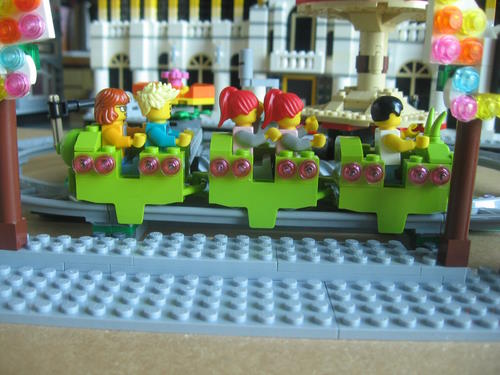
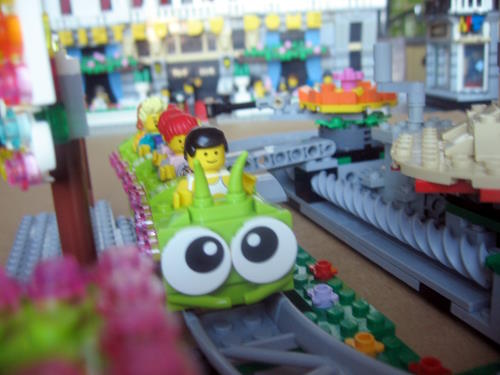
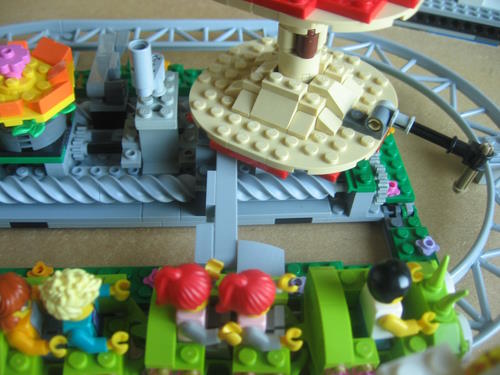
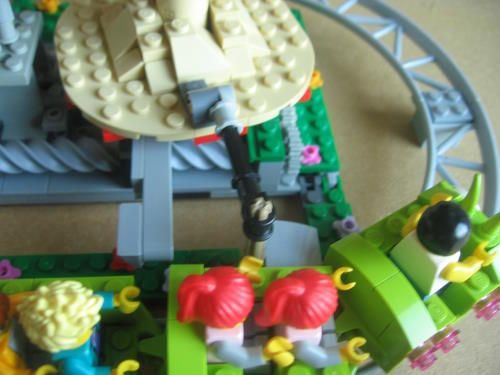
Big Apple
| 
| 
| 
| 
| 
| 
| 
| 
Some "Making of" pictures
The building of this system wasn't as easy as you may think.
The first idea was that there would be 2 straight track pieces in front
and a little hill on the back. The same track as in Bullet train.
In the drawing you can see that when packed, there is just enough room
for the hill when the tracks fold towards each other.
| 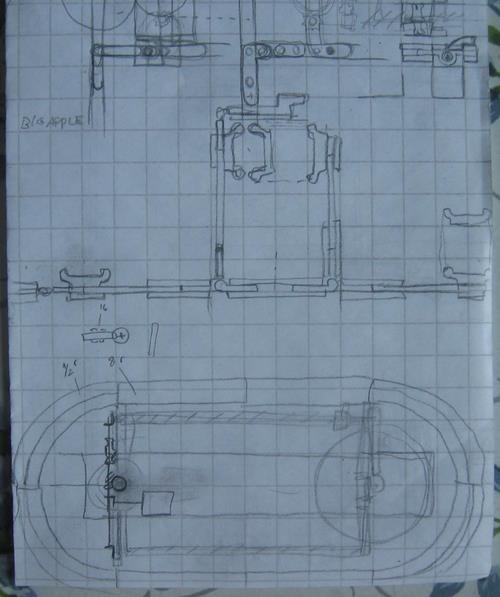
As seen in the drawing above, the arm makes half circle on the curve.
On the straight part the worm screw must make 8 turns in order to carry
the sled from one end to the other. This means that when the axle of the
arm makes one turn the worm screw makes 16. There are 16-tooth gears on
both axles of the arms driven by small worm screws so the ratio is 1:16.
| 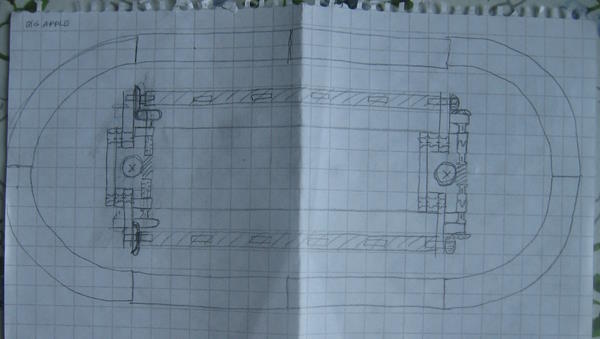
It's too complicated to bring the turning movement to the long worm
screws when they sit on the folding parts. One must use universal joints
so that the axles can go over the hinges. This causes too much free movement
to the axles. So I moved the worm screws onto the chassis of the trailer and
use longer arm to push the train.
Notice that the half circle arms must turn to the same direction at the same time
while one worm screw must turn to one direction and the other screw to the other
direction.
| 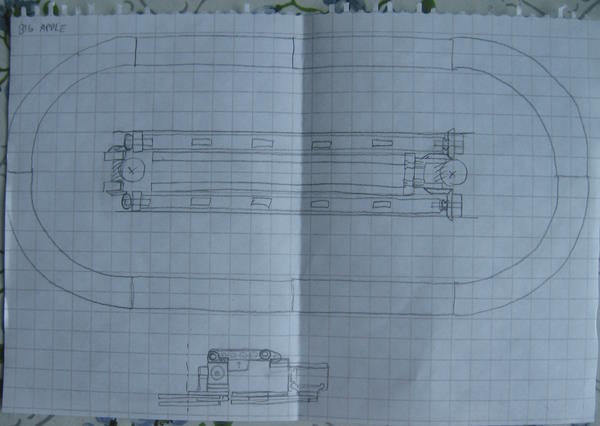
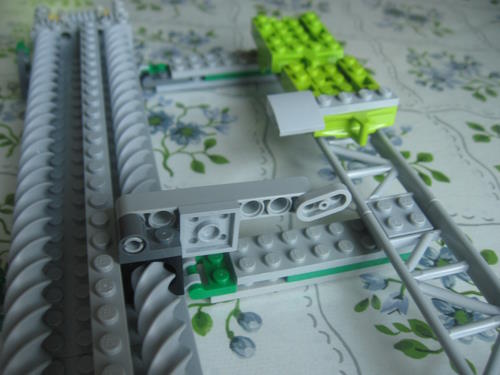
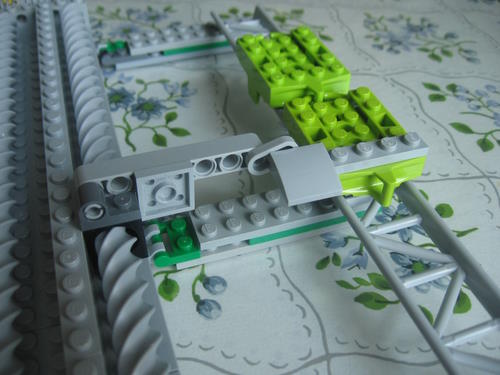
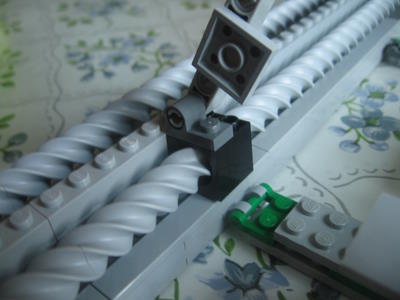
There was still a problem. When the half circle arm is in the end of its path,
the worm screw arm must go over the hook on the side of the train so that it can
get a hold of the hook and continue pushing the train forward. The arms didn't go
long enough and the switch failed. Therefore I made the worm screws longer; 6 pieces
instead of 5 which means 36 studs instead of 30. The straight part is 32 studs long and
the black sled takes 2 studs so the movement went from 28 studs to 34 studs.
The turning arm makes half circle when the sled moves 32 studs so the longer sled
movement means also that the turning arm turns now a little more than just half circle.
This is a good thing, too. I also added a micro motor to turn everything.
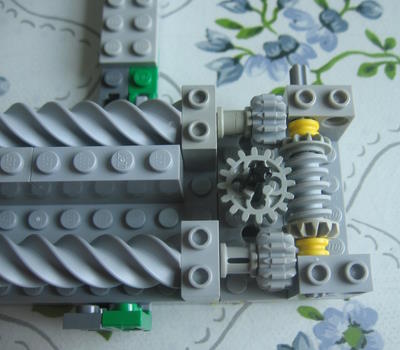
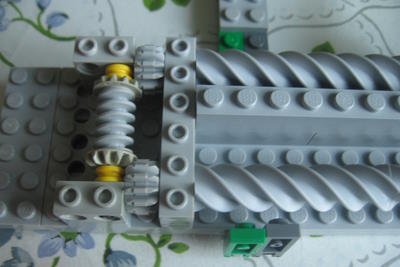
In the upper part of the drawing the worm screw structure is 8 studs wide.
The hinges for the track holders needed also one stud so in the lower part of the
drawing the worm screw system is only 6 studs wide and the half circle arm axles turn
by chain. This is not good because it adds too much free movement and the axle doesn't
turn enough.
| 
| 
| 
| 
| 
| 
| 
| 
| 
| 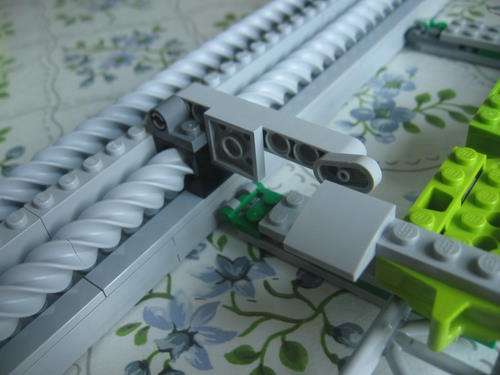
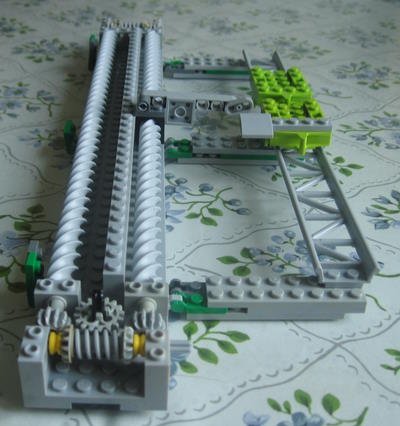
Yet another problem. When the worm screws are this long they are not perfectly
straight anymore but the shape is more like banana. This causes that the sled is not
all the time in contact with the side wall that keeps the sled in upright position
and therefore the arm doesn't stay horizontal but goes up and down.
| 
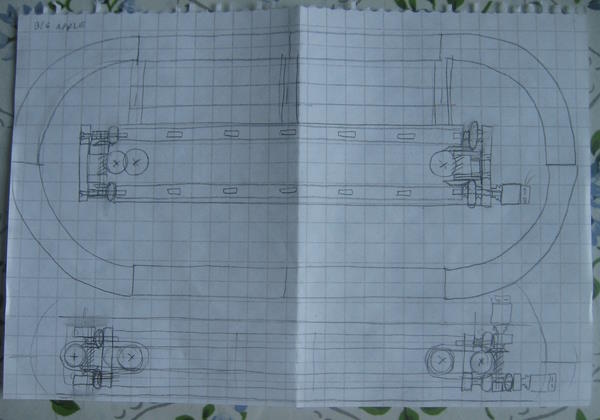
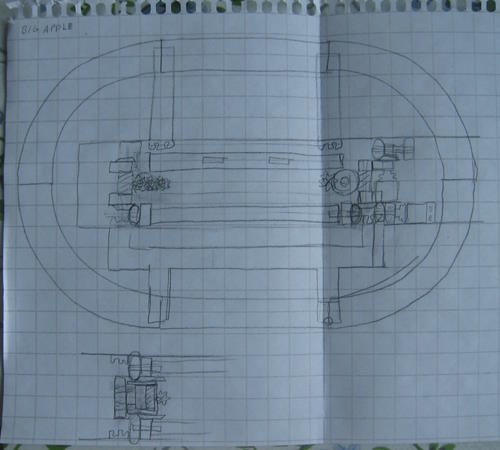
Here the ellipse is smaller, only one straight track part on each side instead
of two. 3 parts long worm screws which means 18 studs long minus the sled (2 studs) = 16 studs.
The straight track part is 16 studs long and the sled (and the arm) movement is 16 studs - perfect.
Because the length of the worm screws is now only half of the earlier ones, the turning ratio
between the half circle arms and the wormscrews is now 1:8 (4 rounds of the worm screw carries
the sled from one end to the other). It means an 8-tooth gear with small worm screw.
Here is two possible places for the motor. The upper worm screw is one stud away from the edge
of the trailer chassis for the track holder hinges but the lower worm screw is at the edge.
The worm screws aren't that long anymore so it's possible to move the hinges outside of the
worm screw area.
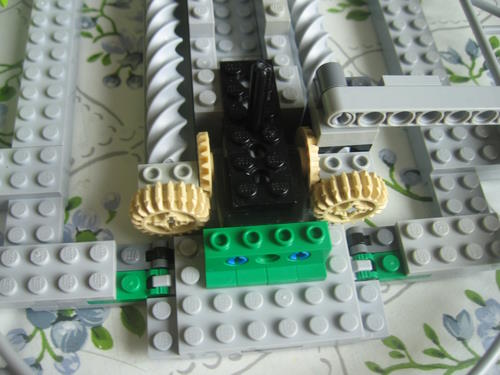
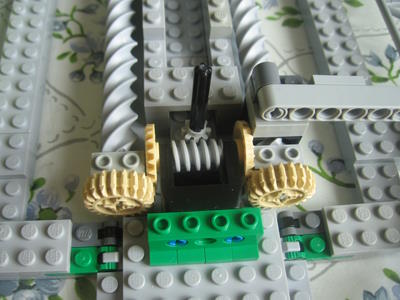
There are three 8-tooth gears in a row for the left hand side half circle arm axle in order to
make the axle turn in the right direction in the right place. Using so many gears causes again
too much free movement. In the smaller drawing the worm screw system is 8 studs wide and
the extra gears are removed.
| 
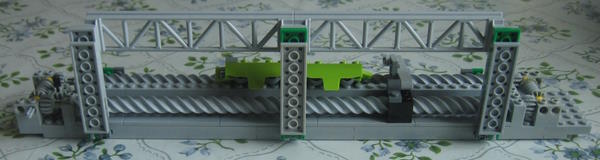
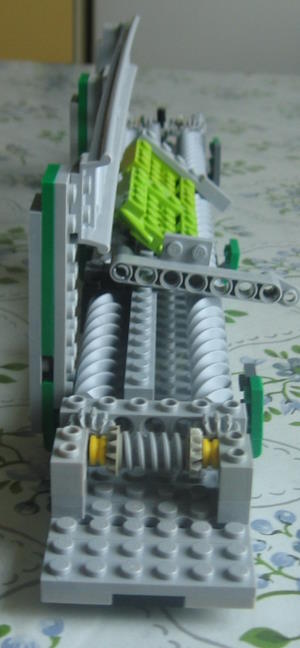
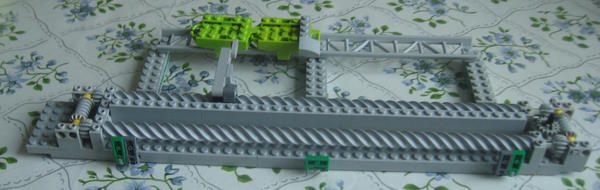
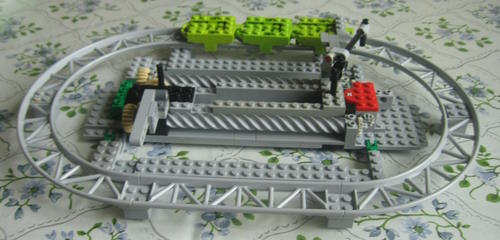
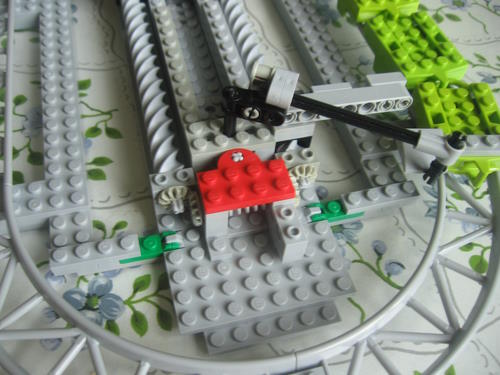
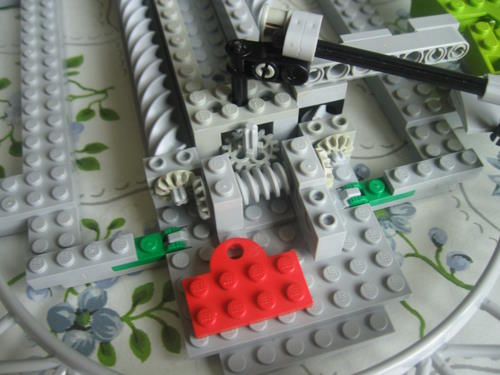
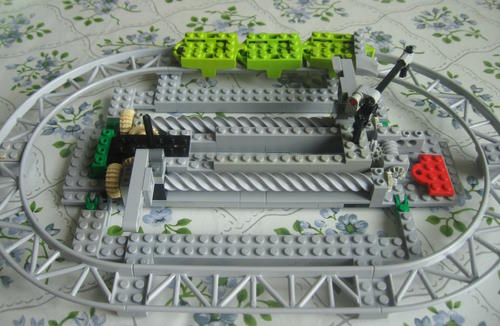
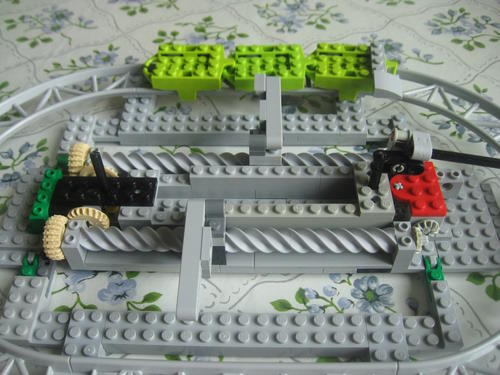
And this is how it looks in bricks.
| 
| 
| 
| 
| 
| 
| 
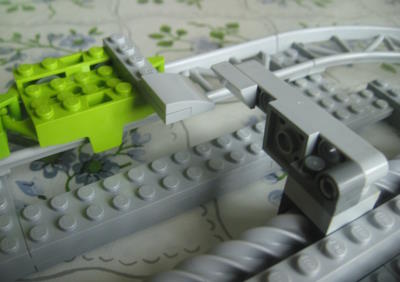
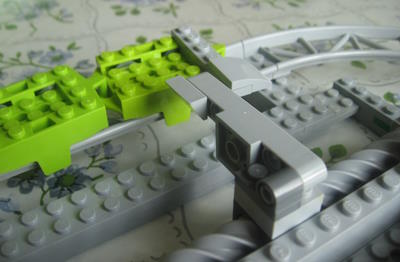
I added a cheese slope to the arm so that it doesn't get stuck to the hook but goes over it.
| 
| 
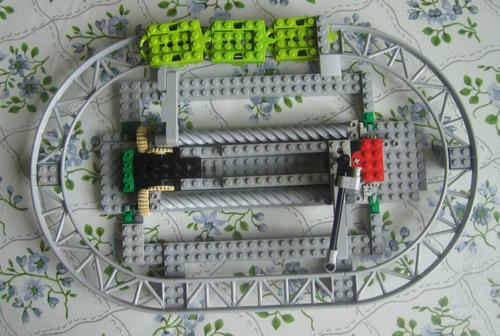
This worked in theory but not in practice. There was still too much free movement and the
switching failed almost every time.
| 
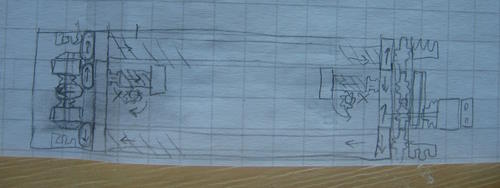
On the left hand side of the drawing there is a simpler structure and on the right hand side even simpler.
I tried to solve the switching problem by moving the vertical axles (the ones with 8-tooth gear)
one stud closer to the center of the trailer. The X in the drawing marks the former place of the
axle. This works because the hook on the train is 2 studs wide. The pin on the turning arm touches
the hook near the side of the train and the worm screw arm at the tip of the hook so they shouldn't
get stuck to each other. Now when the turning axle isn't anymore in the center point of the curve,
the pin of the turning arm travels towards the tip of the hook in the middle of the half circle.
The hook is wide enough for this. At the end of the half circle turn the pin is again near the side
of the train and it doesn't hit the next worm screw arm.
I was also thinking of a system that would change the direction of the motor automatically.
| 
| 
| 
| 
| 
| 
| 
| 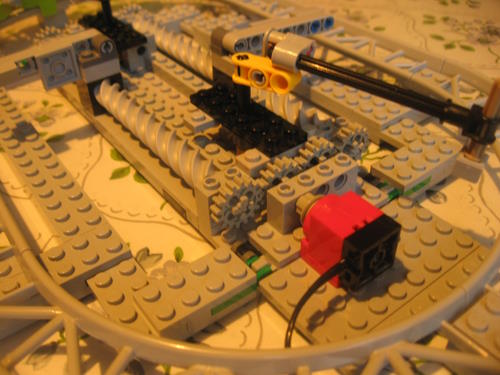
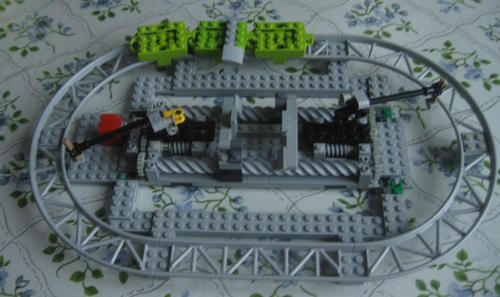
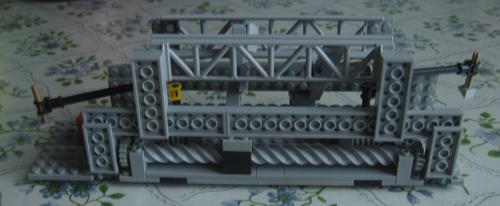
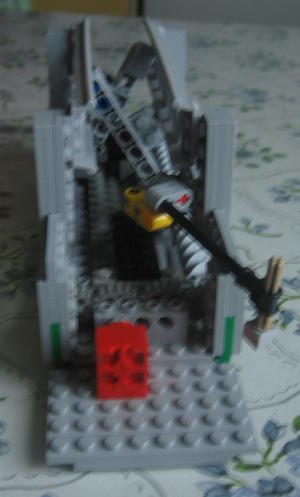
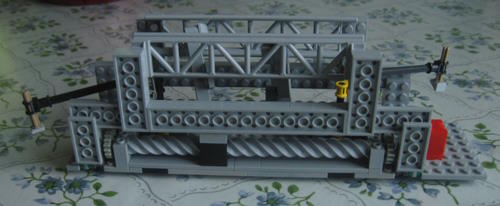
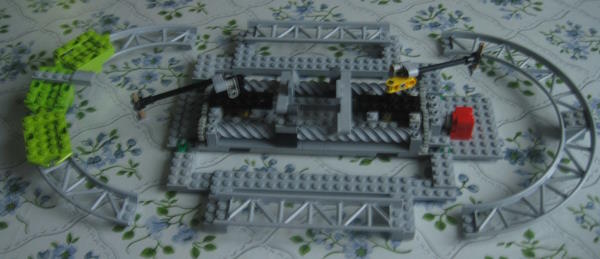
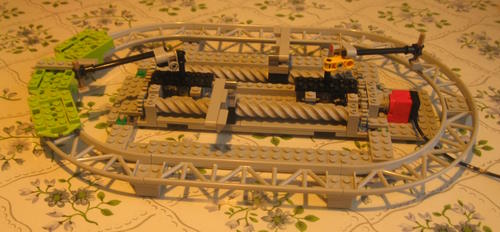
The speed of the train with micro motor was way too slow as you can see in the test video
(the link to the videos is at the bottom of this page). A bigger motor would be too fast without
gears that makes the speed slower and there was no room for that so I switched the motor to a
manual crank. It also makes it easier to control the switches.
| 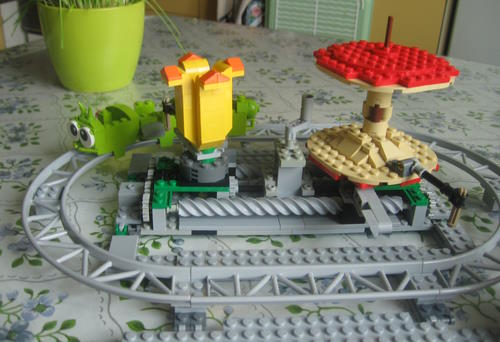
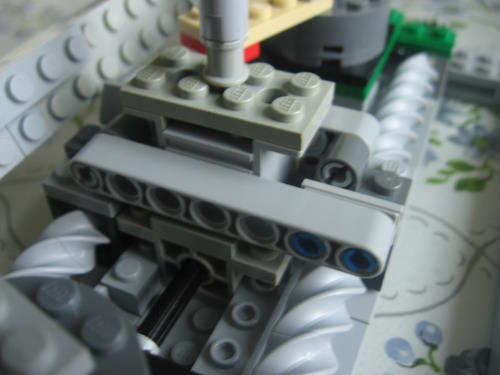
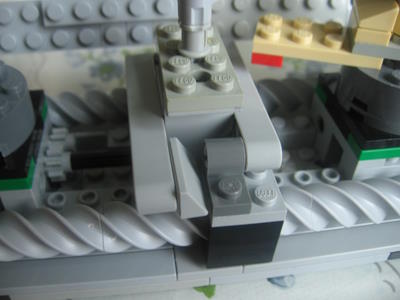
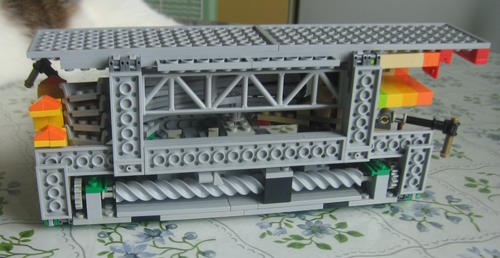
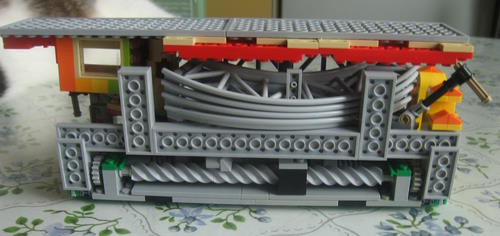
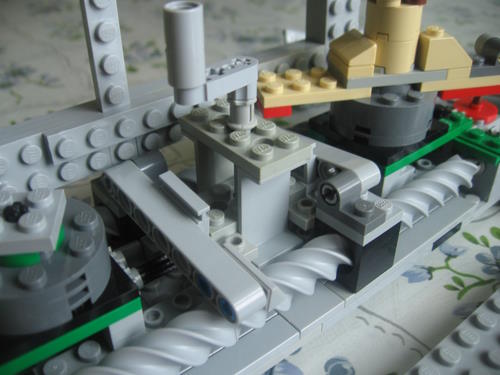
I also made the sled go half stud over the end of the worm screw. This makes the turning arms
turn a little bit more and the switch works better. One stud over the end would have been better
but the sled would have lost its grip of the worm screw. To prevent that there are green 1x2 rail
plates at the both ends of the worm screw to stop the sled.
| 
| 
| 
| 
| 
| 
| 
| 
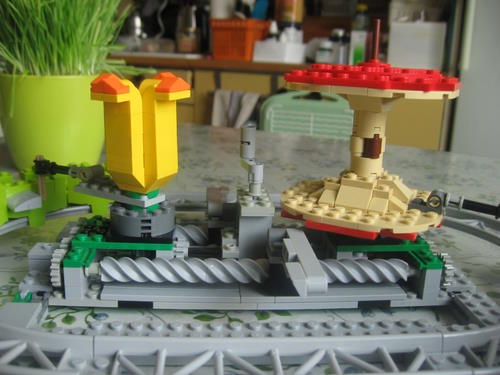
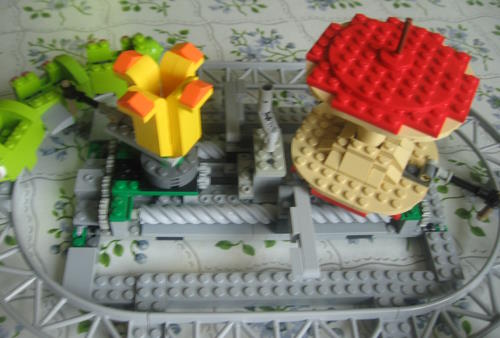
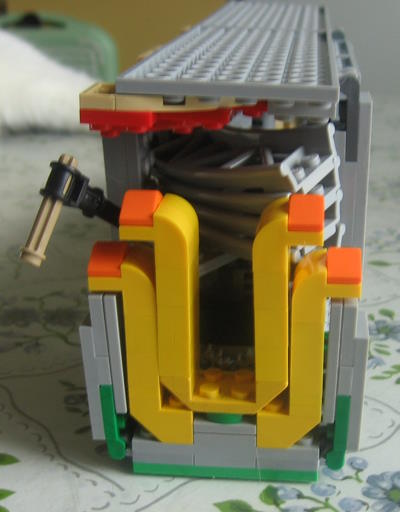
There wasn't really room for a hand between the apple and the flower so I made the
crank taller.
| 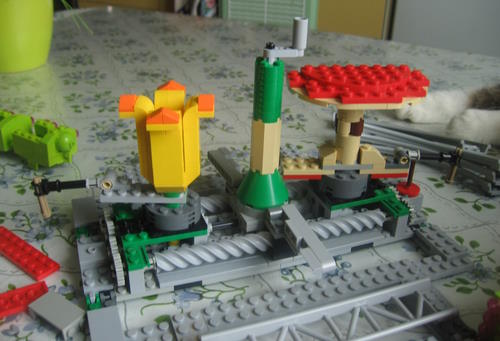
The turning apple misses to hit the base of the crank by less than a millimeter.
The tall crank tower looked stupid so I made the flower lower instead.
| 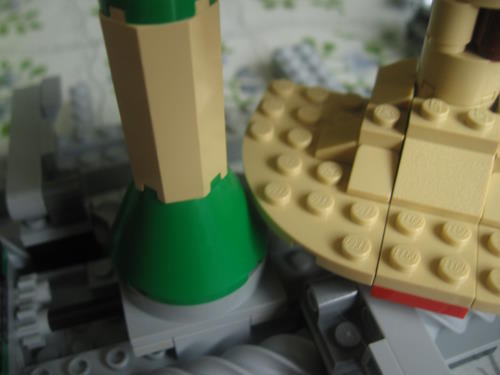
Photo by Adam Floyd
| 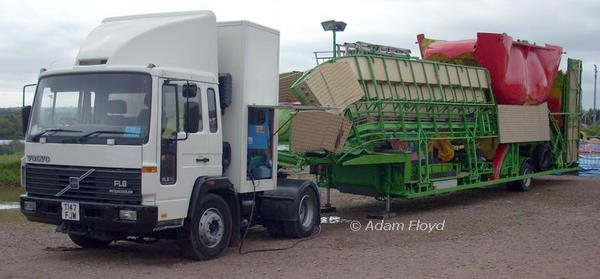
Photo by Adam Floyd
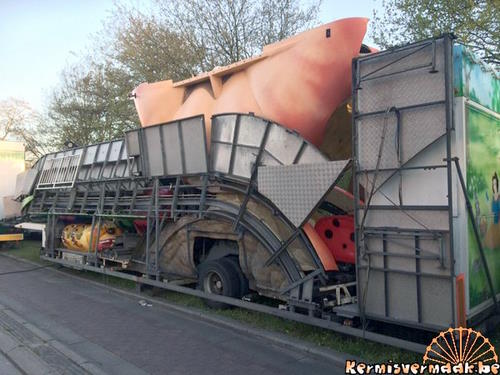
| 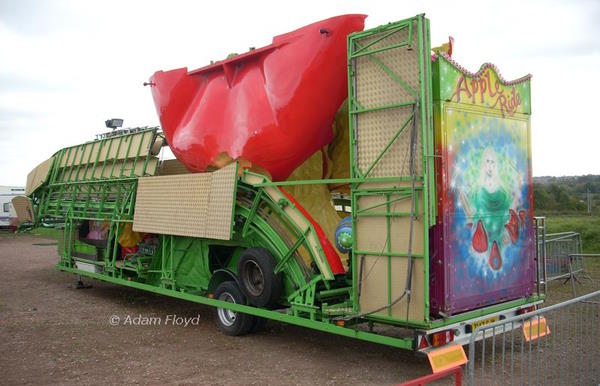
Photo from kermisvermaak.be
| 
| 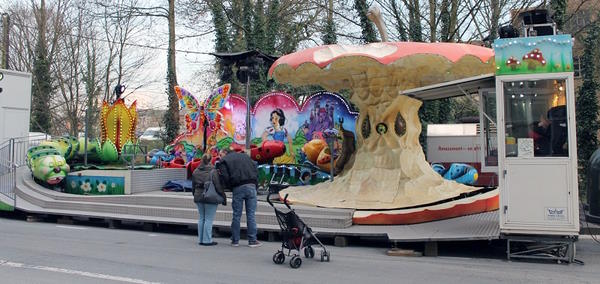
Photo by Marco V.
| 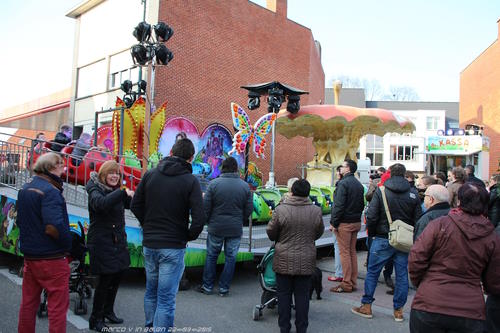
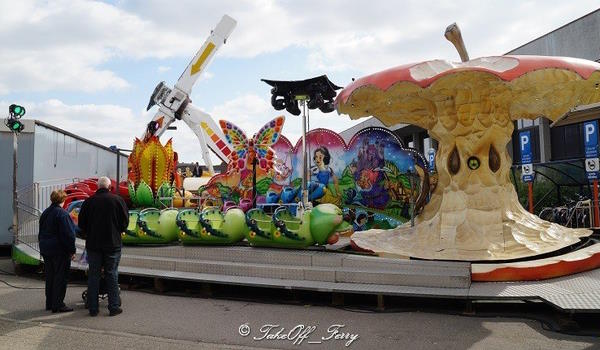
Photo by TakeOff_Ferry
| 
| 
| 
Photo by Tim Holmes
| 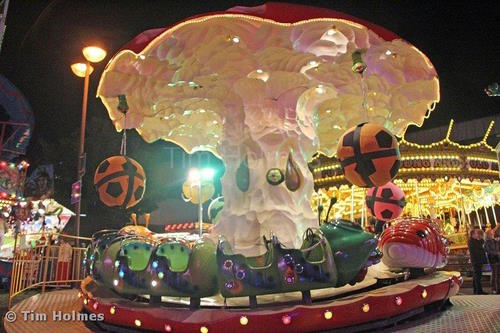
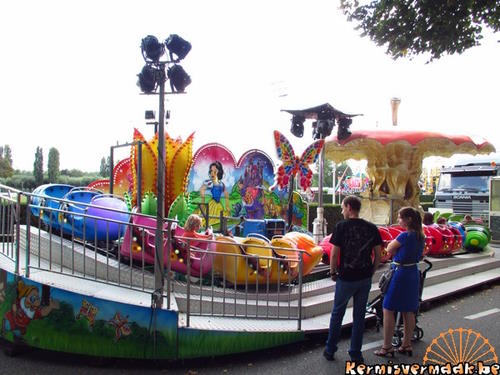
Photo from kermisvermaak.be
| 
Videos here:
Big Apple.mp4
|