Condor
| 
| 
| 
| 
| 
| 
| 
| 
| 
| 
| 
| 
| 
| 
| 
The most difficult thing with this ride was the 4-pole ribbon cable
that gives power for the lift motor and for the spin motor.
Because of the big distance between the bottom position and the
top position of the lift the cable must be quite long.
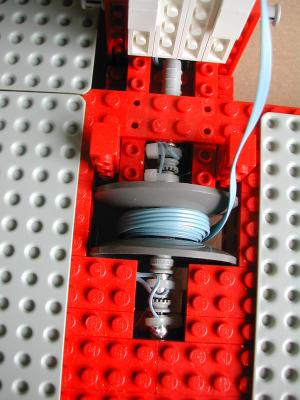
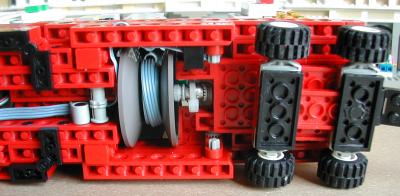
To prevent it from tangling to the moving parts of the ride I put it on a reel.
| 
But how to make the reel spin when the lift comes down?
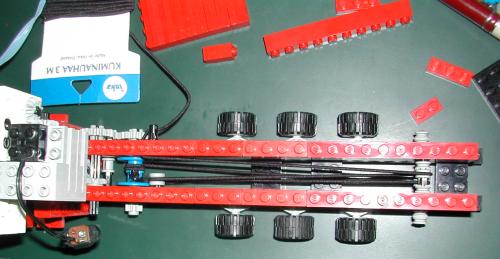
At first I used a rubberband. These two reels (one for the cable and
one for the rubberband) were geared so that when the lift goes up and
pulls the cable from its reel the rubberband gets tighter.
When the lift comes down the rubberband makes the cable reel spin.
Because the rubberband streches only 1/3 from its length it must be 3 times
longer than the cable. This was too much. I geared the reels so that when
the rubberband reel makes one turn the cable reel turns 3 times. That way
the rubberband can be 3 times shorter (= as long as the cable).
I used many pulleys to get the whole rubberband inside of the trailer.
Although the system worked in theory it didn't work in practice.
Back to the drawingboard!
| 
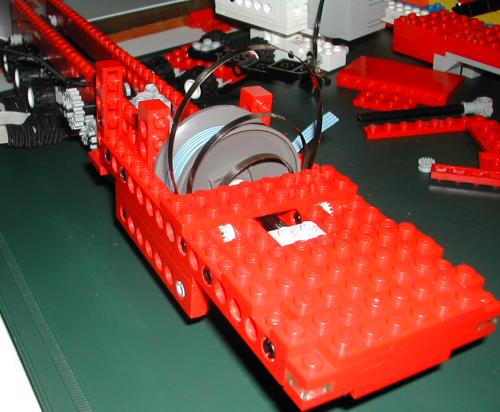
I thought I use a Lego pull-back motor but it couldn't be done because
of the gearing system inside it. Then I used the same idea without the gears:
I took a spiral spring out of an old alarmclock. It wasn't easy to keep in line.
Unfortunately when the spring was under maximum tension the lift has rised only
one third of the tower. Back to the drawingboard!
| 
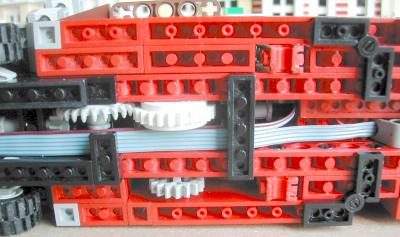
Here is a solution that finally works:
A micromotor turns the reel. It's connected to the same electric circuit as
the lift motor but with a diode so that the micromotor spins only when the
lift is coming down.
| 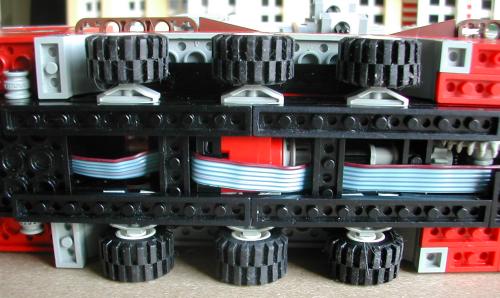
The white torque gear keeps the cable tight enough.
| 
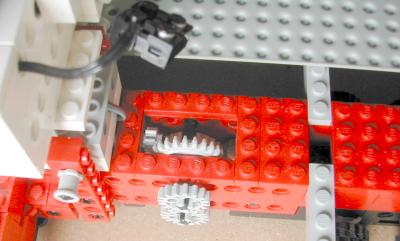
The micromotor and the reel turn at the same speed but the torque gear
turns 3 times faster. This means that the torque is 1/3 lighter.
| 
| 
NEXT
|